
Designing for dignity
"We began our research based on the idea that the built environment can support the individual, the human."

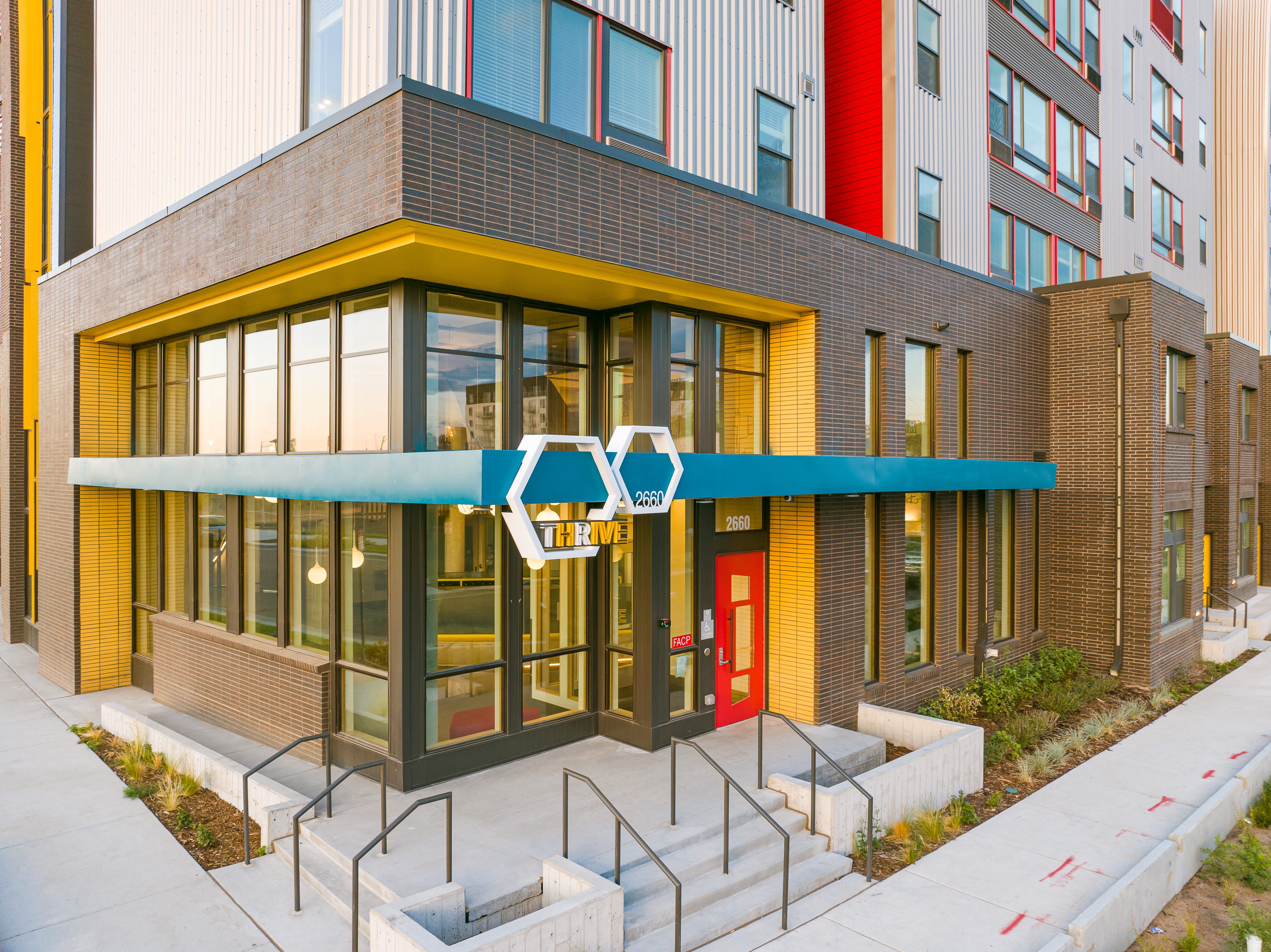
There is a deep and powerful connection between the built environment and public health, and recognizing that intersection changes the way cities are designed and built.
Design choices not only influence the aesthetics of a building but also the way people who live, work, and play in a particular space interact with it. From the amount of natural light in a room to the layout of common areas and the artwork hung on the walls, design creates the experience.
Jennifer Wilson, director of research and impact at ShopWorks Architecture in Denver, has seen how thoughtful, intentional design impacts ShopWorks’ clients. The firm specializes in dignified design, also known as trauma-informed design. Wilson, a trained social worker, is in charge of examining datasets to measure the impact of their work on the people they serve.
That work led Wilson and the ShopWorks team to publish a book about their findings called “Designing for Dignity: Elements of Practice.” Wilson recently told me that the project initially began as a research paper, but it quickly took on a life of its own.
I recently sat down with Wilson to discuss ShopWorks’ new book. This conversation has been lightly edited for length and clarity.

The concept of “designing for dignity” is something a lot of architectural, construction, and engineering firms are talking about, but very few have taken the time to publish those thoughts in a book. Why did ShopWorks decide to take this route?
Wilson: It wasn’t the initial plan. ShopWorks received a two-year grant from the Sozosei Foundation to do outcomes research to better understand how trauma-informed design impacts folks who live and work in these spaces. The research began with observational data collection. We had selected sites that we felt really represented dignified design/trauma-informed design (TID). And then we selected sites that predated the TID conversation.
A group of three researchers with different disciplinary backgrounds, but all familiar with trauma-informed design, collected observational data. We were continuing to collect outcomes data, too. But we thought, “Jeez, this observational data, we already have a lot here.” We started analyzing the data and found that it distilled down to 22 distinct elements.
Through that exercise, we realized it was a very synthesized narrative about what we’re seeing, specifically in housing — attributes that speak to safety, comfort, community, and choice — our core principles of dignified design. So, we thought we would write up a trim little paper to describe these 22 neat elements. Once we started writing that paper, we figured it could actually be a pamphlet. Then we hired a graphic designer, and we added a bunch of shiny, colorful pictures to create a booklet. The booklet then became a book. It was almost like we couldn’t stop adding to it.
There are two terms used interchangeably here that we should clarify: trauma-informed design and dignified design. What are the differences between the two terms, and which one do you prefer?
Wilson: Trauma-informed design is how we began our research, based on the idea that the built environment can support the individual, the human, honoring the human experience and the need to support somatic regulation.
We see dignified design as a trauma-informed approach. But we found that over the years of doing this work, “trauma-informed design” wasn’t always the most honoring term. In housing, we’d share, “This building applied a trauma-informed design approach.” And some people would say that it made them feel seen, that we understood where they’ve been in life. But other people would say, “I don’t need that. I don’t see myself as having experienced trauma.” To be trauma-informed is certainly to be human-centered and to meet a person where they’re at. But something about starting with “trauma” can be really off-putting.
What we have been hearing people say is that when they are in environments that feel life-affirming, that feel like they are meant for them, designed for them, places where they can live their best lives, and be honored in their full human capacity, we feel like these are indications that they’re experiencing their human dignity being honored in the built environment. We want to focus on creating environments that promote this experience of dignity, a more strengths-based and salutogenic (health-promoting) approach.
What does a dignified design look like? How do you know when you’ve achieved it?
Wilson: That is the ultimate question for those of us doing the research: is there a there there? Do you arrive at dignified design? We’ve started using the term dignified design-enhanced buildings to acknowledge the fact that there is a murkiness. It’s more of a spectrum.
We believe that dignified design is highly individualized. It makes a person say, “I feel safe, I feel comfortable, I feel connected and seen, I feel like I have choice and control again.” If the person living in the building is telling us, “This space is working for me, and I feel like I can be my full self and lead a full life here,” then something really positive has been achieved, and we know that it has so much more to do with the full experience than just the building. It’s attempting to convey and instill safety and the three C’s — comfort, community, and control — as much as you can in all the spaces throughout that environment.
How do you measure the impact of dignified designs on the people who live in the building? What about the surrounding community?
Wilson: We’ve been thinking more about the temporal element of the built environment, and the fact that — especially with Permanent Supportive Housing — there is a life cycle to PSH (how the building is living, the dynamics of everyone leasing up at the same time, emotions running high at first and eventually settling down) and a progression to how each resident is moving through that experience (transitioning from experiencing homelessness to being in an apartment building). It’s not that everyone will need the same thing. Certainly, they won’t. But have we thought about different spaces and different experiences in that micro-environment that can meet people as they are evolving, transitioning, going through life stuff, and that can meet the evolving needs of the larger community?
We often talk about the concept of identity anchors, elements that are meant to speak to the people within that environment: the resident, the staff, the guest, or visitor. But they’re also intended to speak to the broader neighborhood, to say this building is not an object in space. We didn’t create it over here in our minds and plop it down into your beloved neighborhood, but we wanted it to fit into the fabric of this place. It’s meant to be additive for all of us. Housing is meant to support and benefit the entire community, and so we do try to think about places that will inspire connection and, frankly, pride.
What project(s) would you point to in the book as examples of what we’re talking about here?
Wilson: There are two that come to mind. One of them is Thrive in Sun Valley, Denver. There is a second-floor amenity deck that overlooks what became a closed school, unfortunately. We put in this huge, beautiful play structure. We went with a company, Earthscape, that does these really beautiful designs. They took the initial design to the community, and they asked the kids what they would like to see and play on. And the kids chose a fox. They chose this big, playful fox. And so Earthscape designed this adorable fox play structure, and it sits on the second-floor amenity deck overlooking the school yard. And it becomes a different sort of association that people have with the building. It becomes more of an affectionate connection to the building that’s meant to add to the landscape and a pop of color and something not blighted but beautiful that has just moved into the neighborhood—and that’s where I live.
There’s another building that we opened on Federal Blvd., St Francis West. As you’re driving north on Federal Blvd., you can’t help but see this building that just makes you smile, and that adds a little bit of personality and playfulness to the neighborhood. The intention is that it doesn’t look out of place. It’s not a sore thumb. This is something that adds joy to the neighborhood within which it’s situated, not meant to be set apart. Instead, I think it does flip the narrative to attempting to create something for the neighborhood that benefits the entire community, that speaks to the entire community.
Grab a copy of “Designing for Dignity: Elements of Practice” by clicking here.